Why You Feel Stiffer, Achier and More Bloated After 50
Fascia Release for weight loss?
A client came to me recently and asked: "Jackie, what do you think about fascia release for weight loss? I keep seeing it everywhere."
And my very first thought was — oh, here we go, another wellness fad.
But because I always dig into the science before I open my mouth, I went away and researched it.
And I have to tell you... what I found completely changed how I think about this.
There is a body system inside your body right now that is directly responding to your falling oestrogen levels — one that influences your stiffness, your bloating, your digestion, and your weight — and most women have absolutely no idea it exists.
By the end of this video, I think you're going to understand your body in a way you never have before. And some of those symptoms you've been putting down to "just getting older"? They're about to make a lot more sense.
Stay with me.
Today we're starting a brand new series, and I'm genuinely excited about this one because it covers something I hadn't given much thought to before — and I suspect you haven't either.
We're talking about fascia.
Now before your eyes glaze over — I promise this is not going to be a dry anatomy lecture. What I want to share with you today is why this particular body system matters specifically to us as women in midlife, and why understanding it could help explain some things that might have been puzzling you for a while.
This is Blog 1 — what fascia actually is and why it changes at menopause. In the episodes that follow, we'll go deeper into the gut connection, the weight and metabolism piece, and then a full practical toolkit of what you can actually do about it.
So let's start at the beginning.
SECTION 2 — WHAT IS FASCIA?
Here's the easiest way I've found to explain fascia.
Imagine peeling an orange. When you get through the outer skin, there's that white, slightly stringy layer underneath — the pith — that wraps around the whole fruit and separates each individual segment. It's not the main event, but without it, the orange would just fall apart.
Your fascia is a bit like that — except it's alive, it's incredibly sophisticated, and it runs through your entire body without interruption.
More precisely, fascia is a continuous three-dimensional web of connective tissue — made mostly of collagen — that wraps around every single muscle, bone, organ, nerve, and blood vessel you have.
It holds everything in place, allows everything to move smoothly against each other, and cushions your organs.
But — and this is the bit that surprised me — fascia is not passive packaging. It's loaded with sensory nerves. It's connected to your lymphatic and immune systems. Some researchers describe it as the body's "master communicator" — constantly relaying signals between different parts of your body.
When fascia is healthy, it's flexible, springy, and well-hydrated. It moves effortlessly with you. You don't notice it. That's how it's supposed to be.
But when it becomes stiff, dehydrated, or develops what researchers call adhesions — sticky patches where layers that should glide freely start to stick together — you absolutely notice it. It shows up as pain, restricted movement, that feeling of tightness that just won't shift, and inflammation that seems to come from nowhere.
Now here's the question that led me down this research rabbit hole: why does this seem to happen so much more in midlife? Why do so many women in their late 40s onwards suddenly feel stiffer, achier, and more restricted than they ever did before — even women who are active, eat well, and take care of themselves?
The answer brings us to something I genuinely didn't know before I researched this video. And it starts with oestrogen.
SECTION 3 — THE OESTROGEN CONNECTION
I want to share a piece of science that genuinely stopped me in my tracks when I read it.
Fascia has oestrogen receptors.
Let that sink in for a moment. Your fascia — that entire connective tissue web running through your whole body — is directly responsive to changes in your oestrogen levels.
Now, we already know that oestrogen affects bone density, muscle mass, mood, sleep, and metabolism. But connective tissue? That was new to me.
Here's what the research found. When scientists exposed human fascial cells to varying levels of oestrogen in laboratory conditions, they discovered that oestrogen levels directly changed how those cells built the fascia itself.
With higher oestrogen — as you'd have in your younger years — your body produces more of something called collagen III and fibrillin. These are the types of collagen associated with elasticity and flexibility. They give tissue that lovely springy quality.
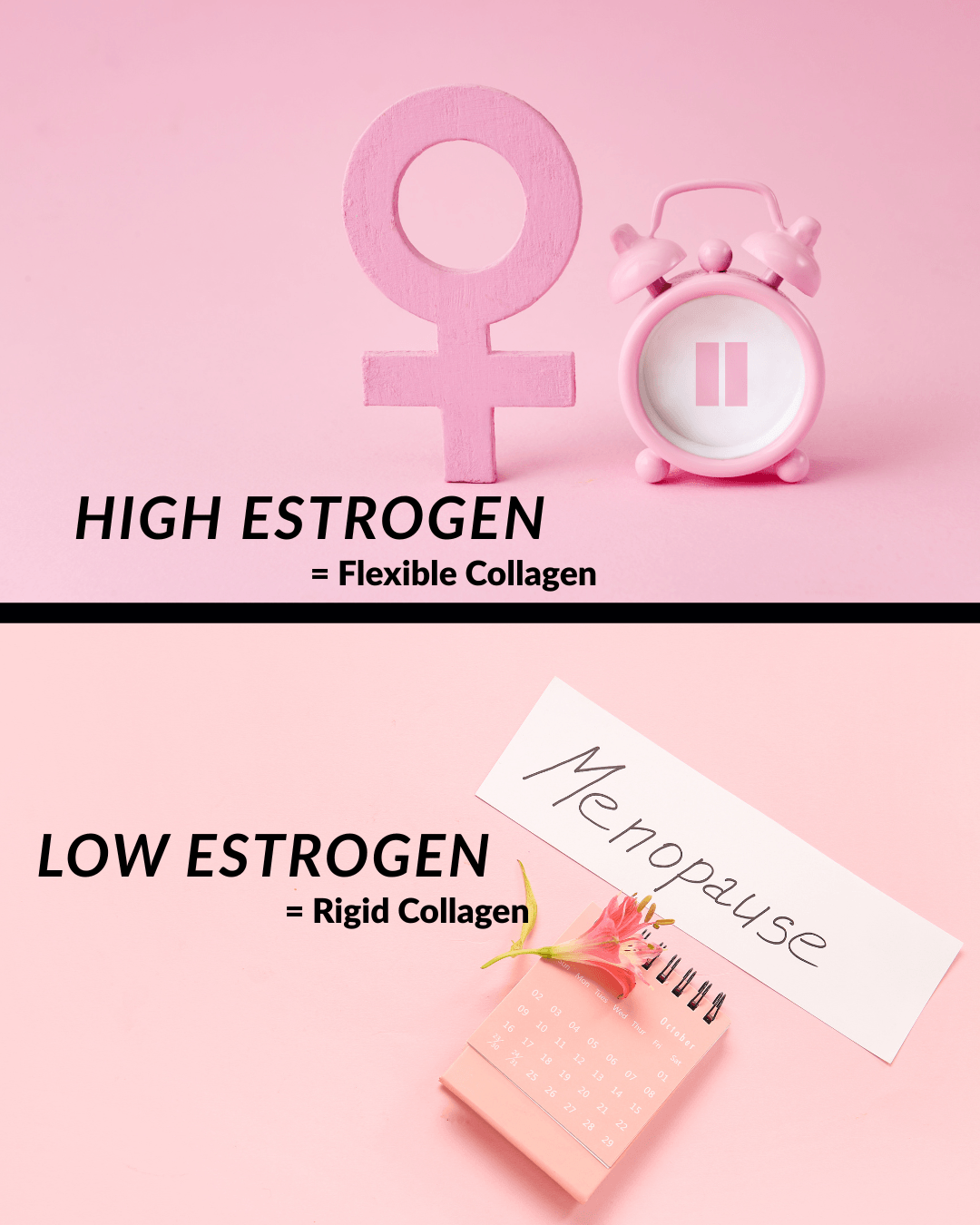
But when oestrogen drops — as it does in perimenopause and menopause — the balance flips. A different type, collagen I, becomes dominant instead. And collagen I is stiffer. More rigid. Less able to stretch and glide.
So your fascia literally changes its structure in response to your hormonal shift.
One study found a 75% drop in collagen levels in the pelvic connective tissue of postmenopausal women not on hormone therapy, compared with pre-menopausal women.
Seventy-five percent. That is not a subtle shift.
And this — right here — is why so many of you will recognise this list.
1. ✅ Unexplained joint stiffness and aching, even though your doctor says there's no arthritis
2. ✅ Frozen shoulder, plantar fasciitis, hip pain — conditions that become much more common after 50
3. ✅ Pelvic tightness or discomfort
4. ✅ Feeling like your flexibility has just... gone. Like your body won't move the way it used to
5. ✅ Skin that's lost its bounce and elasticity
These things are not just ageing. They are not weakness or letting yourself go. They are a specific, biological, hormone-driven change happening in your connective tissue. And understanding that — really understanding it — changes everything about how you approach it.
SECTION 4 — WHY THIS WAS IGNORED FOR SO LONG
So if this is all backed by research, why has nobody talked about it?
Honestly? Because fascia was largely ignored by mainstream medicine (especially when it came to carrying out studies on women!) for a very long time. It was treated as biological filler — the stuff surgeons cut through to get to what they were actually interested in
.
Anatomy textbooks spent pages on muscles and bones and organs, and fascia got a paragraph at best.
But research over the last decade has completely reframed how we understand it. We now know fascia is biologically active, immune-responsive, and deeply woven into how your hormones, gut, metabolism, and nervous system all function.
A 2024 review published in Frontiers in Neurology describes fascia as a regulatory system in health and disease — not a passive structure, but an active participant in how your body works.
And for women in perimenopause and menopause — who are already navigating hormonal changes across virtually every body system — this matters. Because your fascia is not sitting this one out. It's going through the change right alongside you.
SECTION 5 — WHAT THIS MEANS FOR YOUR BELLY AND BLOATING
Now I know what many of you are thinking. This is all fascinating, Jackie — but what does it actually mean for my belly? For my weight? For that bloating that arrives every afternoon like an uninvited guest?
That's exactly where this gets interesting.
Because stiff or restricted fascia in the abdomen and pelvis can compress your digestive organs — affecting how efficiently food moves through your gut, how blood flows to that area, and how your gut communicates with your brain.
Practitioners who work with abdominal fascial release report significant improvements in bloating, cramping, and digestive discomfort in their patients.
And the weight question? The relationship between fascia and metabolism is more connected than most people realise — and there is genuine emerging science on this. But to do it justice, I need to go deeper than we have time for today.
So here's what I'm going to do. Blog 2 is entirely dedicated to the gut-fascia connection — which honestly blew my mind when I read the research.
And Blog 3 is where we get into the weight and metabolism piece, and where I'll give you my honest verdict on whether fascia release is worth your time or just clever marketing.
SECTION 6 — THE TAKEAWAY AND SERIES PREVIEW
One. Fascia is a living, active body system — not passive packaging. It plays a role in your movement, your immune function, your hormones, your digestion, and your metabolism. And it has been largely ignored by mainstream medicine until very recently.
Two. Fascia has oestrogen receptors. When your oestrogen drops at menopause, your fascia literally changes its structure — becoming stiffer, less elastic, and less able to glide. This is a real, biological explanation for the stiffness, aching, and restricted movement that so many of you are experiencing. It is not weakness. It is not just getting old. It is your body responding to a hormonal shift.
Now. Is fascia release actually worth doing?
Does it help with bloating, with weight, with the menopause belly? And how much of what you're seeing online is genuine and how much is marketing?
I'm going to answer all of that — properly, with the science — across the next 3 blogs.
In Blog 2 we go into the gut-fascia connection, which is one of those things that once you understand it, you genuinely can't unsee it. If bloating, digestive discomfort, or that "afternoon belly" is something you struggle with, you will not want to miss it.
And if today's blog resonated with you, please share it with a friend who might need to hear this. So many women are putting these symptoms down to ageing when there's actually a very specific biological reason behind them.
And if you'd like to be part of a community where we go even deeper — where there's coaching, support, and someone who actually reads this research so you don't have to — come and find us on Skool. Scan this QR code to join - it's FREE

Get your Free
Japanese Walking
Reset Plan
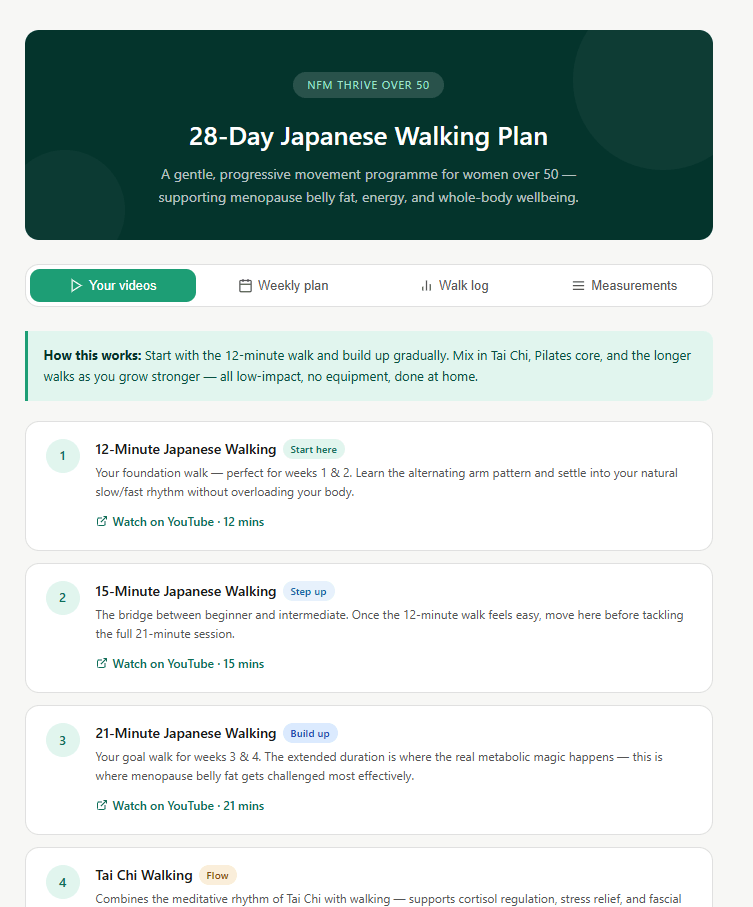
💬 What you get:
A simple 28-day structure (3-4 walks per week)
A guided progress tracker you can use instantly in any browser on your phone or laptop.
A way to track your waist, energy, and wins
Links to my guided walking videos and a bonus Belly Fat Loss Pilates routine to follow along
✅ Simple. Structured. Designed for Real Results.
If you’re over 50 and want to feel fitter, stronger, and more confident — but don’t want extreme workouts or gym pressure — this reset is for you.
I’ve created a simple 28-day Japanese Walking plan to help you stay consistent and actually see progress.
No guesswork. No overwhelm.
Just smart structure that works
Stay Connected with Jackie
Follow me on social media to dive into a world of fitness, nutrition and wellness insights
Let's connect and get healthy together!
Join My Skool ➡️➡️➡️
Community for Women over 50